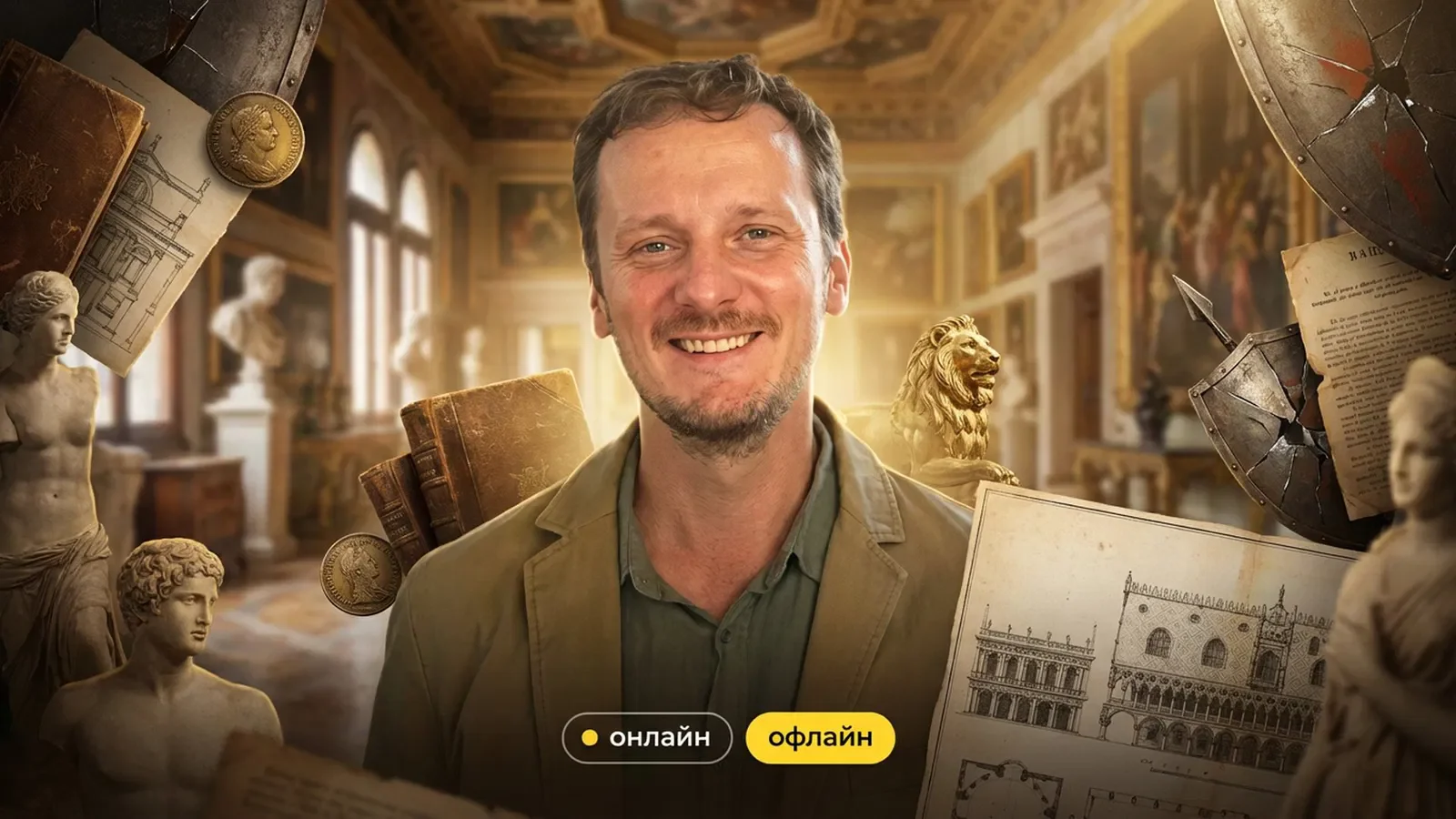
Art — Money — War
About the Lecture
Christoph Büchel confronts contemporary society not with one-time sensational gestures, but with a meticulously documented critique of the “order of things.” His arguments take the form of historical artifacts, provocative 20th-century artworks, and urgent texts — by both contemporary authors and those who may seem long out of date.
In his 2024 exhibition “Monte di Pietà”, presented as one of the most complex and controversial projects of the Venice Biennale, he turned toward the viewer a sweeping revision of what many would rather avoid: war and the staggering rise of global inequality, the art market and collecting, economics and labor relations.
Outwardly, however, he staged it with the азарт of an illusionist — leading visitors through a garbage dump, a strip room with a pole, a chapel (of course), a crypto-mining farm, the private quarters of the “collector” Rybolovlev, and more. Yet all of it was interwoven with thousands of hyperlinks to works by masters ranging from Marcel Duchamp to Andy Warhol.
The exhibition was literally overwhelmed with texts and quotations: from Summa de arithmetica by Luca Pacioli to Bullshit Jobs by David Graeber.
This abundance of material did not cause the exhibition to collapse; rather, it made it one of the most important artistic statements of recent years. From my perspective as an art historian (other specialists may hold different views), it presents a coherent vision of 20th- and early 21st-century art within its real social context — one dominated by financial and debt relations.
This is precisely how I propose to analyze the exhibition: moving from the close examination of disparate sources toward constructing a coherent mind map.
Similar events
Exhibition Reveals Unknown Facts from the Past of a Cypriot Artist
Lithography and Its Evolution

Reimagine
VIMA Art Fair. Contemporary Art Fair
Nature's Forms: A Mixed-Media Exhibition